
Folding Solar Panels are moving from niche camping equipment into mainstream mobile power. Remote workers, overland travelers, emergency teams, and boat owners now want electricity without fixed rooftops. The market looks promising. It is also confusing.
IRENA’s Renewable Capacity Statistics 2024 reported 473 gigawatts of new renewable capacity worldwide in 2023. Solar contributed approximately 346 gigawatts, representing nearly three-quarters of that growth. This expansion supports stronger demand for compact solar products, including Folding Solar Panels. The International Energy Agency’s Renewables 2024 report also identified solar PV as the main driver of renewable growth. As IEA Executive Director Fatih Birol said, “Solar PV is the new king of electricity markets.” His statement concerns solar broadly, not portable panels, but the implication is difficult to ignore.
Real-world buying remains less tidy. A folded panel may fit beside a backpack, yet its hinges, cables, kickstands, and surface coating affect daily performance. Rated wattage can also mislead. Shade from a tent edge, dusty glass, or a weak connector may reduce output sharply. Small details matter.
This guide compares the Top 10 Best Folding Solar Panels for Global Buyers through measurable and practical criteria. We examine output, packed size, weight, durability, charging compatibility, warranty support, and performance in changing light. No ranking is perfect. Regional plugs, import costs, and after-sales service can change the final choice. Still, careful comparison can prevent an expensive mistake beside a silent campsite.
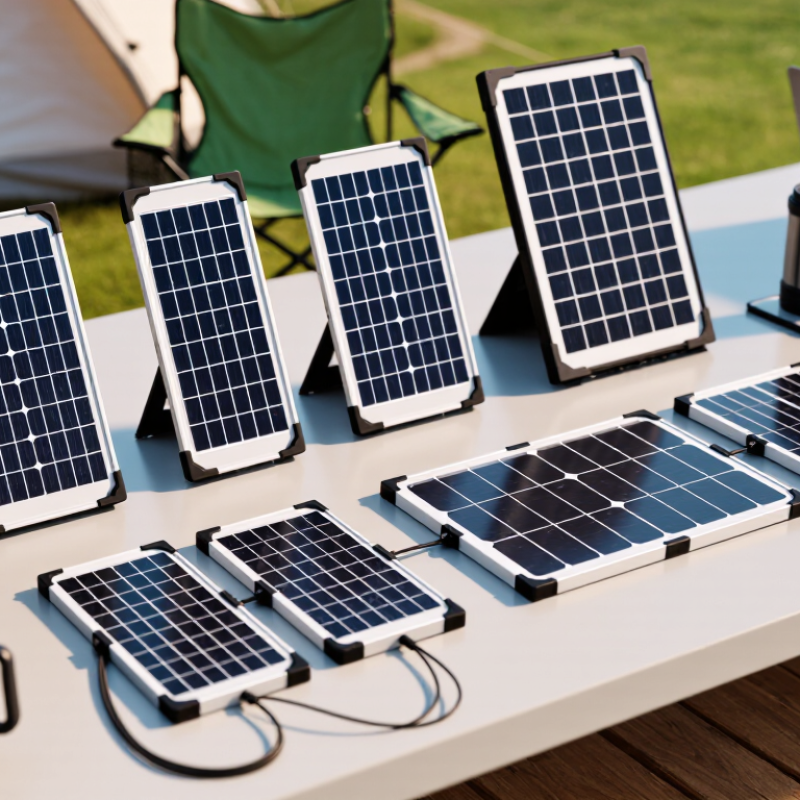
Folding solar panels convert sunlight into direct-current electricity through photovoltaic cells. Most portable designs use crystalline silicon, where photons release electrons and create an electrical flow. Under Standard Test Conditions, or STC, testing uses 1,000 W/m² irradiance, 25°C cell temperature, and an AM1.5 spectrum. A 20–23% efficiency rating therefore represents roughly 200–230 watts from one square metre of active surface.
Real output is usually lower. The IEA PVPS Trends in Photovoltaic Applications 2024 report notes that module performance depends strongly on temperature, orientation, and operating conditions. A panel lying on hot sand can lose power as cell temperature rises. Dust, partial shade, loose hinges, and conversion losses reduce it further. Small details matter.
The National Renewable Energy Laboratory’s Best Research-Cell Efficiency Chart shows how laboratory results remain above ordinary commercial module performance. This gap matters for global buyers. Folding construction adds practical benefits, but it can also introduce weak points at cable joints and cell connections. In field use, a 220-watt rated panel may deliver less during cloudy weather or poor alignment. That is not a failure of the technology. It is a reminder that STC is a controlled benchmark, not a daily promise. A careful buyer should compare active area, temperature coefficients, connector quality, and measured output under realistic sunlight. The rating looks precise. Reality is less tidy.
| Rank | Representative Folding Configuration | Rated Output | Typical Cell Efficiency | Folded Size | Unfolded Size | Approx. Weight | Typical Protection | Common Output Interface | Best Use Case |
|---|---|---|---|---|---|---|---|---|---|
| 1 | Compact 60 W, 2-section panel | 60 W | 20–22% | Approx. 53 × 36 × 3 cm | Approx. 108 × 36 cm | 2.5–3.5 kg | Splash-resistant | DC barrel connector; USB controller optional | Day trips, emergency charging and small power stations |
| 2 | Portable 100 W, 2-section panel | 100 W | 20–23% | Approx. 67 × 53 × 3 cm | Approx. 134 × 53 cm | 4.5–6.0 kg | Splash-resistant | DC barrel connector; MC4-style option | Camping, smartphones, tablets and compact power stations |
| 3 | Lightweight 120 W, 3-section panel | 120 W | 21–23% | Approx. 68 × 53 × 3 cm | Approx. 159 × 53 cm | 5.5–7.0 kg | IP65-class enclosure | DC barrel connector; MC4-style option | Backpacking bases, camera equipment and mobile workstations |
| 4 | Travel 160 W, 4-section panel | 160 W | 20–22% | Approx. 83 × 53 × 3 cm | Approx. 166 × 53 cm | 7.0–9.0 kg | IP65-class enclosure | MC4-style connector or regulated DC output | RV travel, van use and medium-size power stations |
| 5 | High-output 200 W, 4-section panel | 200 W | 20–23% | Approx. 89 × 67 × 3 cm | Approx. 178 × 67 cm | 9.0–12.0 kg | IP65–IP67 class | MC4-style connector | Daily off-grid charging and larger portable power stations |
| 6 | Rugged 220 W, 4-section panel | 220 W | 21–23% | Approx. 97 × 67 × 3 cm | Approx. 194 × 67 cm | 10.0–13.0 kg | IP65–IP67 class | MC4-style connector; adapter dependent | Extended camping, field work and remote communications |
| 7 | 240 W, 4-section reinforced panel | 240 W | 20–22% | Approx. 102 × 67 × 3 cm | Approx. 204 × 67 cm | 11.0–14.0 kg | IP65–IP67 class | MC4-style connector | RV appliances, backup energy and multi-day outdoor use |
| 8 | 300 W, 5-section panel | 300 W | 20–22% | Approx. 102 × 83 × 4 cm | Approx. 255 × 83 cm | 14.0–18.0 kg | IP65-class enclosure | MC4-style connector | High-capacity power stations and mobile base camps |
| 9 | 400 W, 6-section panel | 400 W | 20–23% | Approx. 105 × 100 × 4 cm | Approx. 315 × 100 cm | 18.0–23.0 kg | IP65-class enclosure | MC4-style connector; external charge controller required | Large power stations, disaster response and field operations |
| 10 | 500 W, 6-section panel system | 500 W | 20–22% | Approx. 110 × 100 × 5 cm | Approx. 330 × 100 cm | 22.0–28.0 kg | IP65-class enclosure | MC4-style connector; external MPPT controller required | Professional mobile power, remote sites and emergency backup |
No. A 200-watt rating reflects laboratory conditions, not every campsite. Latitude, clouds, season, angle, and shade reduce practical output. Even a narrow railing shadow matters.
Tropical heat and humidity require sealed connectors and durable fabric. Desert conditions demand heat tolerance, dust resistance, and strong hinges. Cold areas may have bright sunlight but shorter winter days.
Solar cells usually lose output as temperatures rise above 25°C. A coefficient near -0.35% per degree can cause noticeable losses. Poor ventilation makes the panel feel hot by midday.
Match the panel’s DC voltage and connector size with the power station. USB output may suit phones, but larger devices need compatible input specifications. Do not assume an adapter fixes incompatible voltage.
Usually, household plugs belong to the charger or inverter. Check local plug shapes and voltage before purchasing an adapter. Small details prevent frustrating setup problems.
Check folded dimensions, carry weight, cable length, eyelets, and wind stability. Lightweight panels pack easily but may flex outdoors. I prefer one person positioning it securely.
Examine hinges, cable joints, kickstands, connectors, and protective coatings. Try at least ten folding cycles. A loose connector can interrupt charging even when the cells look perfect.
Include purchase price, battery replacement, transport, repairs, and expected energy yield. Divide lifetime costs by usable kilowatt-hours, not peak wattage. I once underestimated transport damage.
Folding Solar Panels offer a practical balance of portability, energy generation, and off-grid convenience for travelers, emergency users, and international buyers. This guide explains how their photovoltaic cells convert sunlight into electricity, with typical laboratory efficiency reaching approximately 20–23% under 1,000 W/m² STC conditions. It also outlines essential purchasing criteria, including IEC 61215 and IEC 61730 certification, suitable IP protection, warranty coverage, power output, folded size, weight, efficiency, and total price.
The ranking compares ten folding panel options by performance and value while considering regional climate, expected solar yield, connector and plug compatibility, and ease of transport. A complete ownership analysis examines temperature coefficients, battery cycle life, material durability, maintenance needs, and estimated levelized cost of electricity. By comparing these factors together, global buyers can select a reliable folding system that matches their climate, power requirements, budget, and long-term use without focusing only on advertised wattage.
