For global buyers, choosing the best solar power station from China starts with the job it must do. A compact unit for weekend camping differs from a backup system for a home office. China has a broad manufacturing base, but that alone does not make every model suitable. The right choice depends on usable battery capacity, continuous output, charging options, and dependable support. A Powerstation Solar product should be judged by its documented performance, not by a large capacity figure on a product page.
Check the battery chemistry, rated watt-hours, inverter output, and solar input limits. Then compare these figures with the devices you expect to run, such as a 60-watt laptop or a small refrigerator. Small details matter. Confirm which plugs are included, how long charging takes, and whether replacement parts or warranty service are available in your destination. Ask suppliers for current test reports and destination-specific compliance documents; requirements can vary by market and product type. A polished listing is not proof. Some sellers explain peak output clearly but leave everyday operating limits less clear, so buyers should request written answers before ordering. This guide compares practical features, supplier transparency, and after-sales considerations to help narrow the options. No single checklist removes every risk. The best choice is the one whose verified specifications fit your use, budget, and support needs.
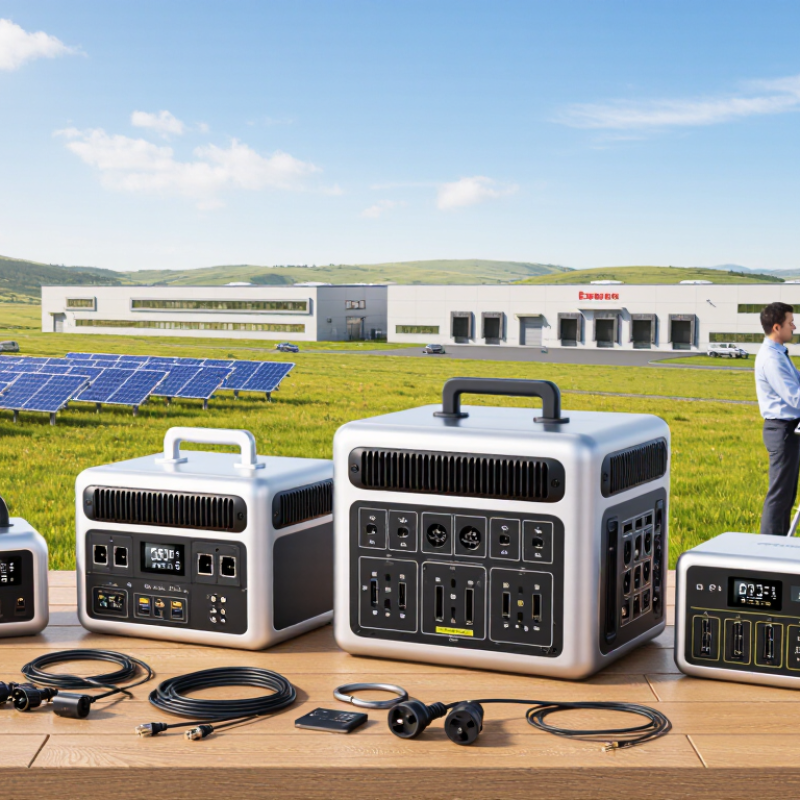
A solar power station converts sunlight into usable electricity through a simple chain. Solar panels produce direct current (DC), and a charge controller regulates power flowing into a battery. An inverter then converts stored DC electricity into alternating current (AC) for appliances such as laptops, lamps, or small refrigerators. Many portable units also provide USB and DC outputs, which avoid conversion losses. The system sounds straightforward. Real-world output is less tidy.
For global buyers, the key is matching capacity to actual use. Check battery capacity in watt-hours, inverter output in watts, and whether the solar input suits the panel you plan to use. The IRENA Renewable Capacity Statistics 2024 report puts global solar capacity at about 1,419 GW by the end of 2023, reflecting solar’s expanding role in energy supply. That figure describes installed solar capacity worldwide, not the output of a portable station. A specification sheet can still mislead if it omits test conditions, charging time, or usable battery capacity.
Tips: Estimate daily energy needs by adding appliance watts multiplied by hours of use. Leave a margin for cloudy weather and conversion losses. Small detail. Keep panels unshaded, and compare real charging tests with the rated input before choosing a unit.
| Dimension | Typical Description or Value | How It Works | What Global Buyers Should Check |
|---|---|---|---|
| Solar power station | A system that converts sunlight into electrical power; it may be grid-connected, hybrid, or off-grid. | Photovoltaic (PV) cells produce direct-current (DC) electricity, which power electronics convert for use or export. | Define whether the project is a utility-scale plant, commercial installation, or standalone power system. |
| PV modules | Modules are assembled into strings and arrays; total capacity is commonly stated in kilowatts-peak (kWp) or megawatts-peak (MWp). | Semiconductor cells generate DC electricity when exposed to light. | Compare module power, dimensions, electrical characteristics, certifications, and product and performance warranty terms. |
| Mounting and site | Fixed-tilt or tracking structures are selected according to the site and project design. | Structures position and secure modules; trackers adjust module orientation to follow the sun. | Assess land, shading, soil, wind and snow loads, corrosion conditions, access, and local permitting requirements. |
| Inverter | String and central inverters are common options for larger PV systems. | Converts PV-array DC electricity into alternating-current (AC) electricity and manages electrical operating conditions. | Check AC rating, DC input limits, grid-code support, protection features, monitoring, and service availability. |
| Energy storage | Optional for grid-connected projects; generally required in off-grid systems that need power after sunlight hours. | A battery stores electricity for later use. A battery management system monitors and protects the battery. | Specify usable energy in kWh or MWh, charge and discharge power, operating temperature, safety provisions, and warranty conditions. |
| Grid connection | Grid-connected stations export electricity through electrical equipment sized for the local network. | Transformers and switchgear adapt and control power for connection to the site network or utility grid. | Confirm local voltage and 50 Hz or 60 Hz frequency, grid-code requirements, interconnection approval, and export limits. |
| Monitoring and protection | Monitoring may report energy production, equipment status, alarms, and system availability. | Meters, sensors, controllers, and protective devices help operators assess performance and respond to faults. | Check data access, communications compatibility, cybersecurity practices, alarm handling, and remote support arrangements. |
| Energy yield | Annual output depends on installed capacity, local sunlight, orientation, shading, temperature, system losses, and downtime. | A site-specific energy assessment estimates production over time; nameplate capacity alone does not determine annual generation. | Request the assumptions behind the energy-yield estimate, including weather data, losses, degradation, and any shading analysis. |
| System type | Grid-connected: operates with the utility grid. Hybrid: combines PV with storage and/or grid power. Off-grid: operates without a utility connection. | System controls coordinate PV output, battery charging and discharging, loads, and grid power where applicable. | Choose based on grid access, load profile, backup needs, required autonomy, and local rules for electricity export. |
| Supplier evaluation | A project offer should identify system scope, equipment specifications, exclusions, and commissioning responsibilities. | The supplier or project contractor coordinates equipment, engineering, installation support, testing, and documentation according to the contract. | Verify relevant test reports and certifications, references, spare-parts plans, delivery terms, warranty process, and after-sales support in the destination market. |
Note: Specifications and energy production are project- and location-dependent. Confirm applicable standards and grid requirements with qualified local professionals before procurement.
It stores electricity, usually from solar panels, and supplies power to household devices. Think of it as a portable battery system.
Panels generate direct current (DC). A charge controller manages power going into the battery, and an inverter converts DC into alternating current (AC). Small detail: USB and DC ports can power compatible devices without inverter conversion.
Multiply each device’s watts by its hours of use, then add the results. Leave room for cloudy weather and conversion losses. Real use is messier.
Roughly ten hours in theory. In practice, inverter losses, cold conditions, and other usage can shorten that time.
Check usable capacity, continuous AC output, and surge rating. Motors may need extra power when starting, so a small pump can demand more briefly.
Match the station’s solar input limit and supported voltage range to the panel. Compare rated input with real charging tests; the figures may not tell the whole story.
USB-C, AC sockets, and 12V outputs can reduce adapter clutter. A compact unit may handle phones, a camera, and a small light, but check its usable capacity.
Compare battery capacity with the devices you need overnight. Check ventilation, operating temperature, and safety documentation. I would double-check the usable-capacity figure; product details can be vague.
They can offer long cycle life, but may add weight. That trade-off is easy to underestimate when carrying a station outdoors.
A solar power station converts sunlight into electricity through photovoltaic panels, then stores or supplies that energy using a battery, charge controller, and inverter. Chinese manufacturers produce a range of options, from compact portable units for travel and backup to larger systems designed for homes, businesses, or off-grid applications. The right Powerstation Solar solution depends on how and where it will be used, as well as the buyer’s budget and energy needs.
Global buyers should compare usable battery capacity, output power, charging speed, port selection, battery chemistry, and compatibility with solar panels. They should also consider product quality, clear technical documentation, and consistent production standards. Before placing an order, confirm relevant safety and product certifications for the destination market, packaging and shipping arrangements, warranty terms, replacement-part availability, and after-sales support. Matching specifications and service conditions to the intended use helps buyers make a practical, informed choice.
